Research
Interstellar medium in galaxies
Galaxies are gravitationally bound systems of stars, gas, dust, and dark matter. Understanding the physical properties of the interstellar medium (ISM), the gas and dust that fill the space between stars, is crucial, as the ISM regulates star formation and ultimately drive how galaxies evolve.
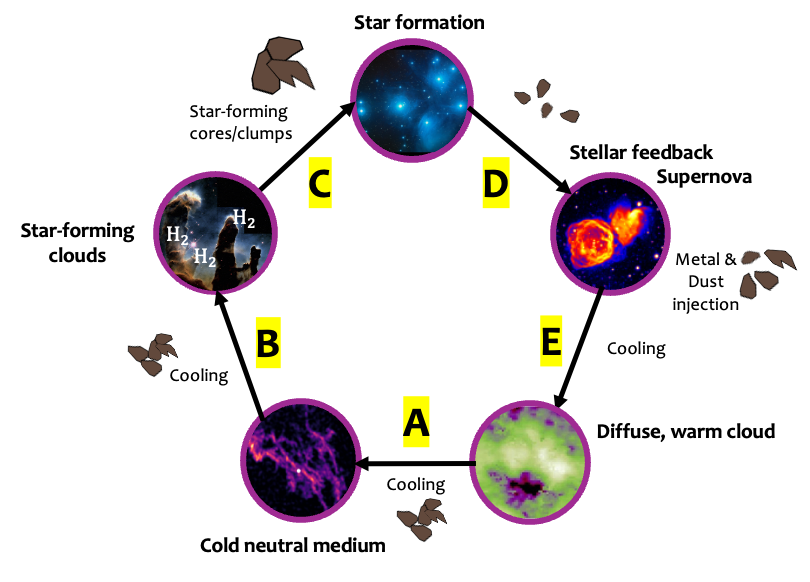
The ISM, composed of gas, dust, cosmic rays, and magnetic fields, it evolves through a continuous cycle:
(A) diffuse, warm gas cools down to form the cold neutral medium;
(B) this gas further condenses into molecular clouds dominated by molecular hydrogen (H2), where dust grains help the gas cool, shield it from radiation, and catalyse the formation of new molecules;
(C) stars form within the cold, dense cores of these molecular clouds;
(D) over their lifetimes, stars synthesize heavy elements through nuclear fusion;
(E) stellar winds and supernova explosions return this enriched gas and dust to the ISM, fueling the next generation of star formation and driving the chemical evolution of galaxies.
Galaxies in the observable universe span a wide range of sizes, luminosities, and physical properties, including stellar, gas, and dust masses, as well as metal abundance. Based on their morphology, galaxies are commonly classified as early-type (elliptical), late-type (spiral), or irregular systems.
The Milky Way (MW), which hosts our Solar System, is a massive, metal-rich spiral galaxy with prominent spiral arms and a central bar. Late-type galaxies like the MW typically have high stellar masses, while their ISM accounts for only ~10-20% of the total baryonic mass. They are generally metal-rich (Z ~ 0.5–1 Z☉) and contain dust at roughly 1% of the gas mass, corresponding to a dust-to-gas ratio (DGR) of ~0.01. Their relatively high molecular gas content sustains ongoing star formation.
In contrast, dwarf irregular galaxies have lower stellar masses but much higher ISM fractions, reaching up to ~50% of the baryonic mass. The Small Magellanic Cloud (SMC), a satellite of the MW, is a well-studied example of this class. Such systems are typically metal-poor (Z < 0.5 Z☉), exhibit low molecular gas content, and contain little dust, with DGR values below 0.01.
What draws me to these dwarf systems is that their low metallicity and gas-rich, dust-poor environments make them local analogues of galaxies in the early Universe — giving us a nearby laboratory to study conditions that would otherwise only be observable at extreme cosmological distances. Dwarf galaxies also behave differently from their larger counterparts in several intriguing ways: their star formation proceeds under harsher, more chaotic conditions; their kinematics are often dominated by a much higher dark matter fraction; and their ISM shows physical behavior that isn't yet fully understood. One such puzzle — and the focus of my current research — is the sub-millimetre excess emission observed in these low-metallicity systems.
My research - Dust properties and sub-mm excess in low-metallicity systems
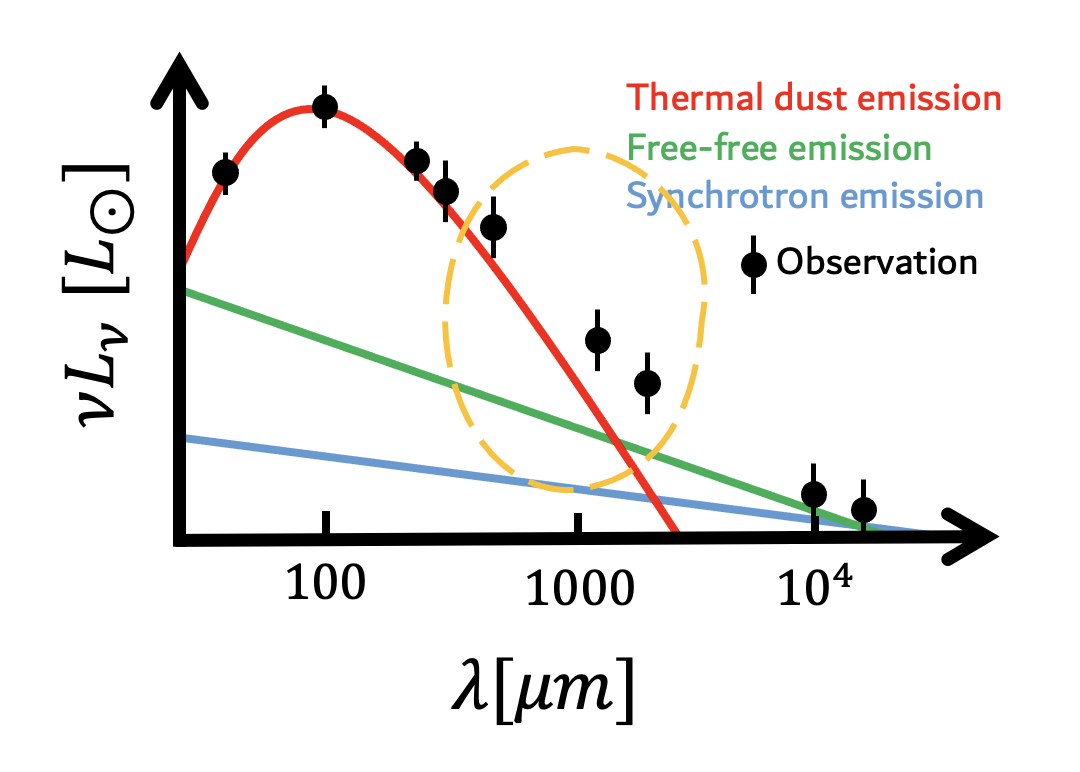
This excess emission at sub-millimetre (sub-mm) wavelengths cannot be explained by current spectral energy distribution (SED) models, which include standard dust emission, free-free, and synchrotron components, and its physical origin remains unknown.
My work investigates this phenomenon using high-resolution observations from the IRAM 30m telescope with NIKA-2 at 1.15 and 2 mm, focusing on nearby dwarf galaxies from the IMEGIN and SEINFELD surveys. By resolving the sub-mm excess on spatial scales comparable to ISM structures, I aim to constrain its origin and assess its connection to dust properties and ISM conditions in low-metallicity environments.