Kinematically colder HI gas as a tracer for star forming gas
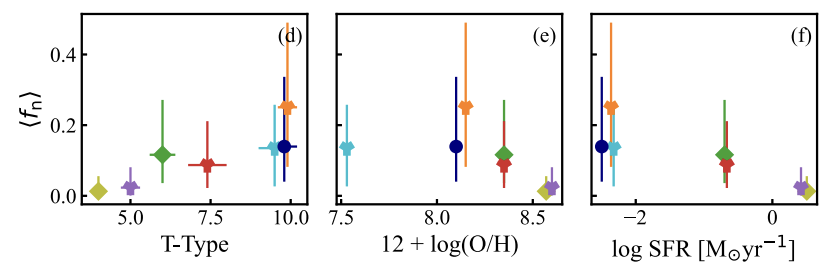
Atomic hydrogen (H I) dominates the mass of the cold interstellar medium, undergoing thermal condensation to form molecular gas and fuel star formation. Kinematically colder H I components, identified via kinematic decomposition of H I 21 cm data cubes, serve as a crucial transition phase between diffuse warm neutral gas and molecular hydrogen (H_2). We analyse these colder H I components by decomposing H I 21 cm data cubes of seven nearby galaxies - Sextans A, NGC 6822, WLM, NGC 5068, NGC 7793, NGC 1566, and NGC 5236 - spanning metallicities (0.1 < Z/ Z⊙ < 1.0) and physical scales (53-1134 pc). Using a velocity dispersion threshold of 6 km s−1, we classify the kinematically distinct components into narrow (colder) and broad (warmer). Cross-correlation analysis between the narrow H I components and H_2 or star formation rate (SFR) surface density at different spatial scales reveals that dwarf galaxies exhibit the strongest correlation at ∼ 500-700 pc. The radially binned narrow H I fraction, fn = I_narrowHI/I_totalHI, in dwarf galaxies shows no clear trend with metallicity or SFR, while in spirals, fn is lower in inner regions with higher metallicity and SFR. We find that the data set resolution significantly impacts the results, with higher physical resolution data yielding a higher median fn, ⟨fn⟩, per galaxy. With this considered, dwarf galaxies consistently exhibit a larger fn than spiral galaxies. These findings highlight the critical role of cold H I in regulating star formation across different galactic environments and emphasize the need for high resolution H I observations to further unravel the connection between atomic-to-molecular gas conversion and galaxy evolution.